

By Sean Cronin, The National Newspaper
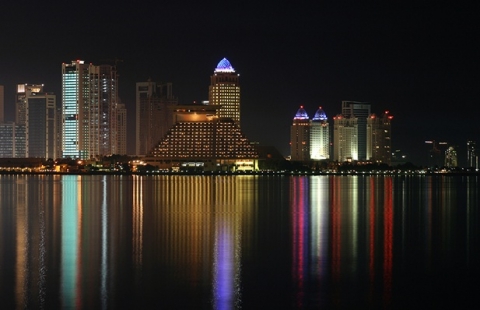
Qatar's capital now has more office space than Abu Dhabi. It is best appreciated at night as the gleaming new towers of West Bay are illuminated in futuristic neon outline.
The city's ongoing construction boom has delivered 3.5 million square metres of accommodation for the banks, insurance companies and fund managers that it is bidding to attract. Almost half of this is considered to be grade A office accommodation built to appeal to such potential occupiers.
By comparison, Abu Dhabi has about 2.7 million sq metres of offices, a little over a third of which could be considered to be top end, according to research from CBRE, an international property consultancy.
But the Qatari capital still trails Dubai in its availability of commercial space, where a six-year building boom delivered some 6.6 million sq metres of office space, almost half of which lies empty today.
The similarities between the two cities and their ambitions to develop as regional financial hubs are obvious as is the over-development of office blocks in both locations.
But government intervention is coming to the rescue of
Doha's saturated office market in the form of the bulk
leasing of towers that is mitigating the impact of the
glut of empty buildings
"The scale of development here is still much smaller to
the overbuild that took place in Dubai," says Shahzad
Shahbaz, the chief executive of QInvest, a Qatari
investment bank.
"Maybe in commercial real estate there has been some
overbuild. But if you look at the normal growth of the
economy here, a lot of the stock will get absorbed. In
Dubai even if you have good growth, the scale of the
overbuild is such that I'm not sure all of that will get
absorbed."
A decade-long spending spree on global property has
resulted in Qatar acquiring a string of trophy buildings
including Harrods, the luxury London department store as
well as a stake in the company that owns Canary Wharf,
also in the British capital.
Now Qatar is building its own trophy developments at home
that extend beyond gleaming new office towers to shopping
centres, museums and a raft of football stadiums for the
2022 World Cup.
It is reminiscent of Dubai during its boom years, right
down to the names of the contractors on the cranes.
Arabtec, one of Dubai's biggest builders that helped
construct the Burj Khalifa in addition to scores of other
towers around the emirate, is now making much of its money
in Doha, where its signboards can be seen dotted around
the city.
Qatar's success in its bid to host the 2022 World Cup has
revived the fortunes of the construction sector, which had
suffered a similar slowdown to the one experienced by
other Gulf states in the wake of the 2008 financial
crisis.
Now some US$65 billion (Dh238.76bn) of investment is
required in the sector over the next decade in preparation
for 2022.
"The key risk remains the actual sustainability of all
planned facilities," says Matthew Green, the head of
research and consultancy in the UAE for CBRE in a
report.
"For a country as small as Qatar, the prospect of a post-
2022 glut must be carefully considered."