
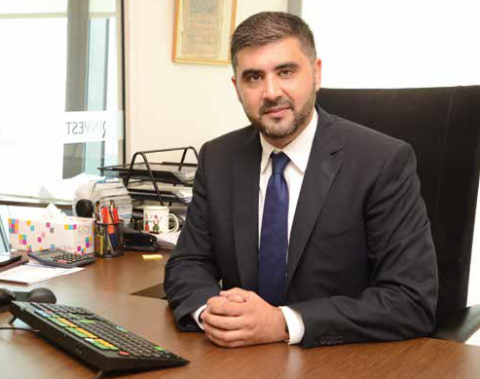
Leading Qatari investment bank, QInvest expects an increase in investor appetite for Shariah compliant funds. However in spite of this optimistic view, Islamic funds and the asset management industry is still geographically confined in certain parts of the world. Speaking to Dr Ataf Ahmad, head of asset management at QInvest, NABILAH ANNUAR investigates the conundrum facing the Islamic funds sector.
The overall Islamic industry is estimated to have reached
US$2 trillion. Less than 4% of this amount vested in
investment funds. A well accepted fact, Shariah compliant
funds are dominated by GCC and Malaysian providers, as
well as a very limited number coming from more established
financial centres. As the sector is dominated by groups
based in emerging markets, this is reflected both in the
investment choices available to clients and the
infrastructure supporting the industry. Some of the
biggest global sectors such the global pension fund
industry have a very small component in Islamic assets,
despite Muslims making up a sizeable component of the
global population.
The question is, after years of progress, why is the
Islamic funds industry still small? According to Ahmad,
factors such as heavy emerging markets focus, regulations,
sub-standard infrastructure, and quality of investment
managers are among the reasons for the small market share.
“The heavy emerging markets focus, which ends up
delivering highly volatile performance, is not appealing
to many retail investors. Sub-standard infrastructure and
set-ups also do not appeal to professional investors.
Regulatory challenges are also existent as a lot of funds
are domiciled in countries where the legislation is
unclear and it is difficult to sell cross-border. One of
the biggest challenges is the actual quality of the
investment managers and their skillset, which often lags
behind conventional managers. Finally a major challenge is
the lack of a globally accepted common definition of
‘Shariah compliant’,” vented Ahmad.
Another predicament highlighted is the dearth of talent.
Top tier professionals are rarely drawn to Islamic asset
management and this poses a problem for the industry as a
whole. Ahmad pointed out: “More works needs to be done in
promoting the sector as one which has the highest
standards and is a compelling career choice for people
from all backgrounds, and that this is not a niche only
for Muslims. More could and should be done to highlight
the strong overlap with environmental, social and
governance (ESG) factors and show that the appeal is to a
much wider potential audience.”
There is an increase in non-Shariah investors across a
range of products and investments in the industry. The
types of non-Muslim investors looking at Shariah products
can be broken down into two groups: (1) investors that are
attracted to the ethical and social characteristics of the
assets Shariah funds invest in, those which view ESG
factors as an important investment criterion; (2)
investors who look to Islamic funds to diversify their
portfolios away from certain assets that are more
prominent within conventional funds and are seen as being
more susceptible to economic volatility. In terms of
investor appetite, retail clients are usually drawn to
brands that they recognize or to products that are
recommended by the sales teams. “The important thing to
remember is that a well-managed Islamic fund can perform
just as well and if not, actually better than a
conventional peer,” affirmed Ahmad.
Click here