

An independent publication by Upper Reach
Qatar’s hydrocarbon-generated wealth, regulatory
environment and relatively unsaturated market, has
portfolio managers turning their backs on Dubai in favour
of Doha, while local asset management firms continue to
invest billions in Europe, the US and beyond.
With a total private wealth pool of $3 trillion, the Gulf
has become an increasingly popular destination for asset
management companies and investment banks. Dubai has
served as the Gulf Cooperation Council’s financial hub for
many years, but it now faces competition from other Gulf
cities such as the Qatari capital of Doha to attract
financial services firms and asset managers.
Oil and gas-generated riches have helped Qatar to have the
highest GDP-per-capita income in the world. Amongst the
population of 2.1 million, more than 80% of which are
expatriate workers, there are estimated to be 300
“ultra-high-net worth” individuals worth at least $30
million, including 12 billionaires. The tiny emirate has
the third highest concentration of millionaires in the
world after Singapore and Switzerland; nearly 50,000
households hold private wealth of at least $1
million.
Attracted by Qatar’s wealth, a regulatory environment on
par with the UK, an attractive tax regime and a relatively
unsaturated market, portfolio managers are turning their
backs on Dubai in favour of the Qatar Financial Centre
(QFC) in Doha. Global index compiler MSCI upgraded Qatar
to emerging market status in May 2014; and CEO of the QFC,
Shashank Srivastava has said that “Qatar is one of the
very few countries that can offer emerging-market returns
at developed-market risk levels.”
In 2012, Barclays became the first international bank to
have a sizable fund management operation in the emirate
after it signed an agreement with the Qatar Asset
Management Company to co-invest $250 million in the
portfolio of Barclays Natural Resource Investments.
Now Barclays is one of a number of UK financial services
firms to have a regional HQ in Doha. Amongst them is AES,
an asset management company which specializes in serving
Qatar’s wealthy foreign workers. With such a high density
of expats looking for guidance on investing some of their
enormous tax free salaries, the draw of Doha for companies
such as AES is too big to ignore.
“Qatar has potential because of the amount of expatriate
and contracted wealth that is accumulated here. You have
got a population in excess of 2.1 million, of which the
local population is somewhere in the region of 300,000.
That gives huge opportunity of capturing investment wealth
from all the other parties that are here,” says Rupert
Bastick, General Manager of AES International Qatar.
“Given that we practice proper financial services with UK
exported best practice, we thought that this was a very
good and viable opportunity,” he adds. “So therefore the
amount of potential clients that would be available was
the biggest factor for us. It was a good business
opportunity.”
While British companies such as AES serve wealthy expats
in Qatar looking for an investment company adhering to
high UK standards, local bank QInvest, in which the Qatari
Investment Bank is the largest shareholder, has helped
rich Qataris to make billions of dollars of
Shariacompliant investments in Europe and the US.
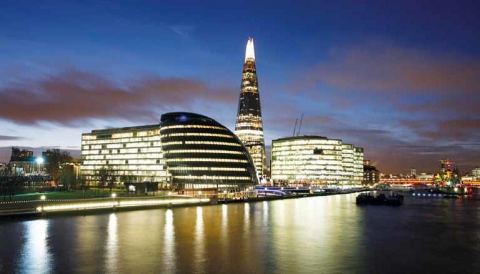
From Harrods to The Shard, Qatari investment in London is
well documented. QInvest was part of the consortium of
Qatari banks that developed The Shard, but it has since
sold its stake in Europe’s second tallest building. The
bank’s other high-profile European purchases include
several industrial property and hotel assets in Paris.
In 2013, QInvest announced that it would be refocusing its
attention from an oversaturated European market to the US,
while at the same time, streamlining its business into
three divisions: investment banking, principal investments
and asset management. Since then the bank has bought a
number of properties in Manhattan, including a retail
podium in the Golden Triangle of the upmarket New York
borough.
The European Central Bank’s quantitative easing programme
– together with a weak euro and low oil prices – has
however compelled QInvest to focus attention in Europe
once again. In January it announced a partnership with
Pioneer Investments, a management firm with more than $246
billion in assets, to create a Sharia-compliant fund that
will be used to invest in European blue-chip, mid and
large-cap stocks.
Another local asset management firm that has earned the
respect of investors and industry peers both in Qatar and
the region is Amwal. Wholly owned by Sheikha Hanadi bint
Nasser Al Thani, one of Qatar’s most successful
businesswomen, Amwal was Qatar’s first regulated
investment company. In November, it was named “Best Asset
Manager” in Qatar by EMEA Finance for the fourth
consecutive year, and according to the CEO, it is the only
asset manager in Qatar whose fund, the Qatar Gate Fund,
has outperformed the Qatar Exchange Price Index every
calendar year since 2006.
Qatari wealth, as well as investment in large-scale
infrastructure projects in the buildup to the 2022 FIFA
World Cup, will continue to be a big draw for both local
and foreign financial services firms. While renowned asset
managers such as AES thrive off the market of wealthy
expats, local companies such as Amwal and QInvest will
continue to shape future investments in the Qatar, Europe,
America and beyond.
Click here